Choose the view you want to remember
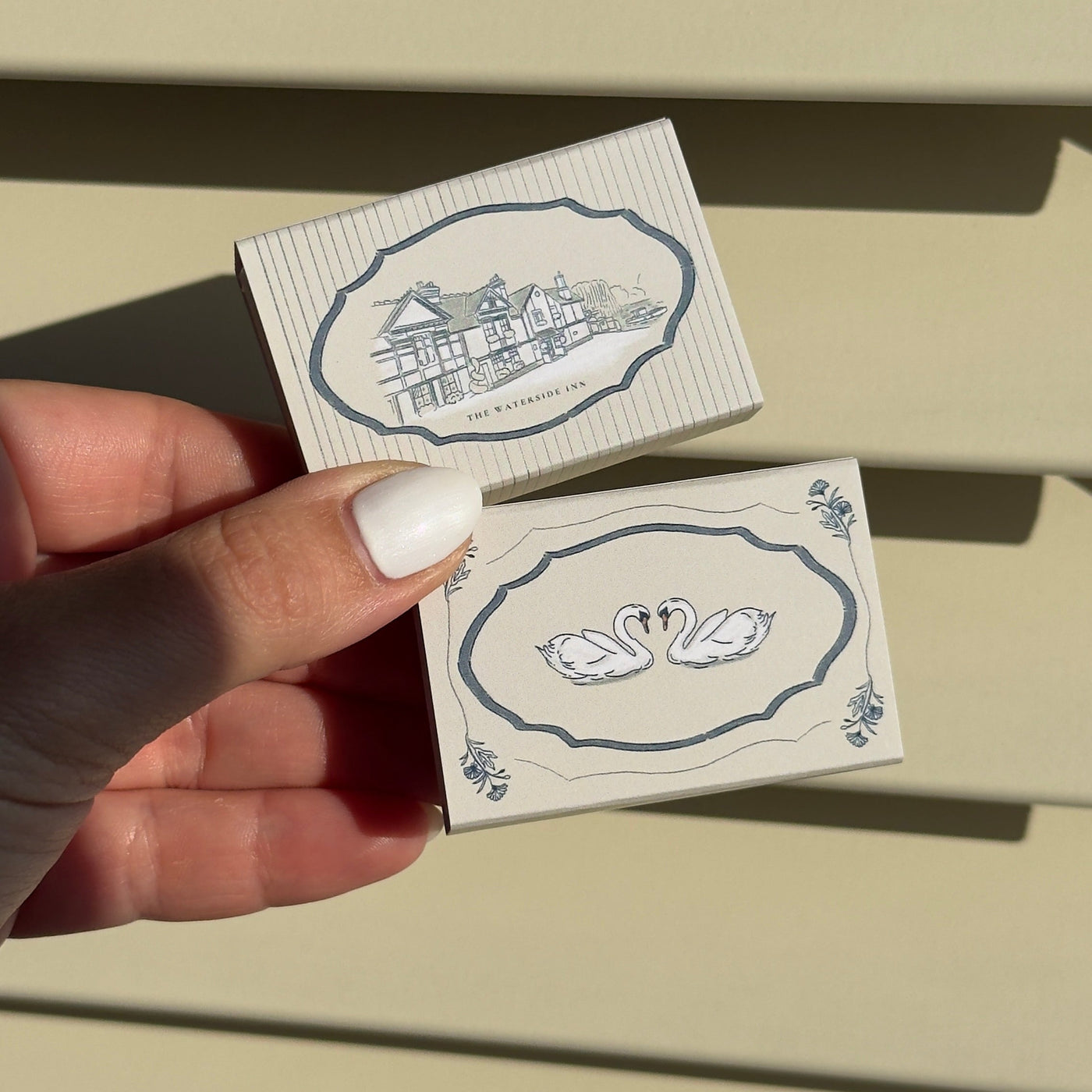
A wedding venue can mean a whole building, a garden doorway or the window beside your dinner table. Choose the view with a personal connection before deciding which details belong in the drawing. A recognisable silhouette often gives a small matchbox more character than a crowded architectural scene.
For example, a courtyard wedding might suggest an arch and climbing leaves. A city celebration might begin with the entrance and its lettering. These are possible starting points for a brief, rather than a fixed menu of designs.
Send photographs that answer different questions
Include one clear photograph of the overall view and a closer image of any feature you particularly want included. Tell us which details matter and which can be simplified. A photograph taken straight towards the building is useful for its proportions; a second angle can explain a doorway or roofline.
Use photographs you own or have permission to share. If your references show different seasons, specify whether you prefer bare branches, summer foliage or a simplified architectural drawing. Add your names, the exact date wording and any existing invitation artwork that should guide the composition.
Give the illustration room
At matchbox scale, every line competes with the names and date. Consider the venue on one face and the wording on the reverse. Alternatively, keep a small architectural motif above a short line of text. Choose one main subject so that both the illustration and lettering remain legible.
A restrained colour palette can connect the box to your stationery without reproducing the entire invitation. If you are considering foil or another specialist finish, ask how much detail the chosen process can retain before the artwork is finalised.
Review the proof as a printed object
Look at the digital proof at approximately the proposed printed size, as well as enlarged. Check names, date, the selected view and the placement of any important architectural details. A screen preview helps confirm the composition, but it cannot reproduce the exact feel of paper or the way a finish reflects light.
Before commissioning, share your quantity, delivery destination and event date. Confirm the proposed finish, price and schedule with the studio. Once the brief is agreed, the proof gives you a clear point at which to review the artwork before production.